Introduction

Exiled Jacobites, elopements and sex scandals, military adventurism and merchant plunder - this blog traces the story of my Scottish forebears in India - and particularly Madras - over a century from 1735 during the period of the East India Company.
Written as a record of my travels to Madras during a trip in November 2024, I hope to visit some of the places still remaining that tell their story, while staying at the delightful 'Madras Club' established in 1835 and reputedly where 'Madras Mulligatawny' soup was first served - the quintessential culinary coupling of 'East' and 'West', after which this story has been named.

Three families - each respectively companions-in-arms and contemporaries of Stringer Lawrence, Clive of India and a young Arthur Wellesley - are researched through this journey, their stories all coming together, via colonial Melbourne and Queensland, as ancestors of my maternal-grandfather's mother. Although the families' stories also each extend to other parts of India - particularly Bombay, Calcutta and the military establishment of Fort Chunar just south of Benares on the Ganges - this journey will centre on Madras which is common to all three families and the place of both their earliest arrival in India as well as their latest departure.
The Forbes Family
The only-known son of Charles Forbes of Brux, a hapless and hopeless Jacobite hanger-on who through incompetence was largely responsible for the failure to take Edinburgh Castle in the 1715 Rising, Roderick Forbes arrives at Fort St George in 1735 with an Ensign's Commission in the East India Company, perhaps hoping to step out of his father's not-so-formidable shadow. A distant kinsman of John 'Bombay Jock' Forbes of Bellabeg, founder of the oldest company still extant in India, our branch of the Forbes family is nevertheless the earliest to make the journey from their roots in Aberdeenshire, Scotland.

The Porterfield/Paterson Family
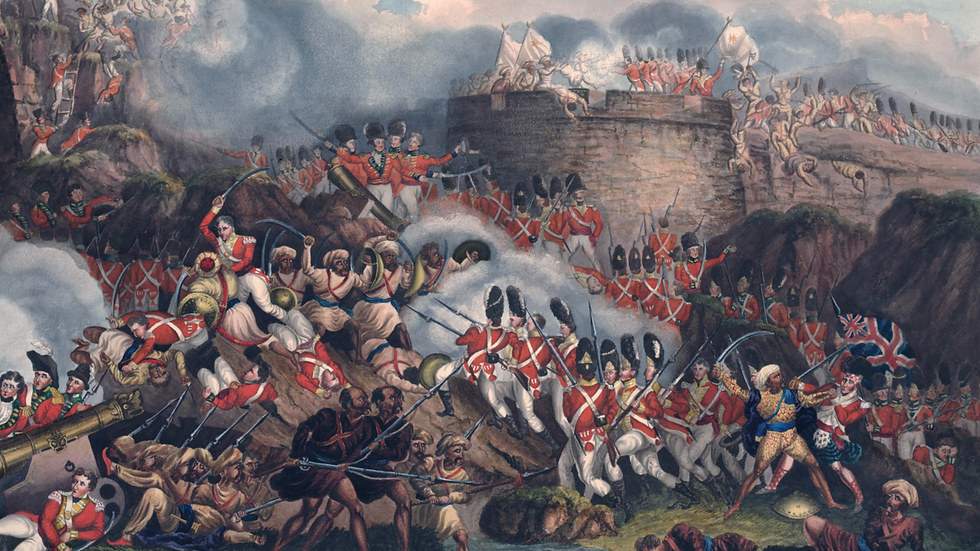
In 1784 Anne Porterfield, the teenage daughter of the Laird of Duchal House, Renfrewshire, eloped to Calcutta with a young officer in the Bengal Army, James Turnbull. Pursued by a cousin who is sent to ensure they are validly married by the Fort William chaplain, she then abandons her new husband and turns her affections to her cousin instead but, being unrequited, moves to Madras where she begins a relationship, which would become marriage after Turnbull's death two years later, with another young officer, Thomas Paterson of the 19th Light Dragoons. Rumoured to be also a lover of Arthur Wellesley, later Duke of Wellington, her salaciousness would be continued by her daughter Helena whose affair, and later marriage, with the Duke's rakish nephew, the 4th Earl of Mornington, scandalised society. Undismayed by domestic stressors, Thomas Paterson rises to the rank of Lt Colonel and plays a leading role alongside Wellesley at the Battle of Seringapatam and subsequent skirmishes.
The Hart Family
William Main Hart, son of the Presbyterian Minister of Kirkinner in Wigtownshire, Galloway, makes his way to Madras as a Merchant in his mid-20s in the early 1790s. He gets involved in some shady trading with his brother, Major Thomas Hart of Castlemilk, who is accused of embezzling funds from a supposedly private supply of rice provided by William Hart for the maintenance of the army on the eve of the Battle of Seringapatam. Major Hart is sure to compensate for any short-comings with a hoard of loot taken after the battle, including the personal sword and gun of Tipu Sultan, unearthed in a family attic in 2019 and sold at Bonhams for a fortune. His brother William prospers as a merchant in Madras, and two further generations are born there before the move to Melbourne, Australia in the 1850s.


More please.