Part One: the Forbes Family

Updated: Jul 10, 2025
Jacobites, Pirate Hunting and Clive of India...
The story of my family’s century-long association with India begins in an Edinburgh tavern on the 9th September 1715. The Jacobite Standard having been raised only days earlier by the Earl of Mar at Braemar, a plot was underway that night to capture Edinburgh Castle in the name of the Old Pretender. Amongst the conspiring chevaliers was my 7xgreat-grandfather Charles Forbes of Brux – head of a minor branch of the ubiquitous Forbeses of Aberdeenshire. Charles was a committed Jacobite – having lead a delegation two years earlier to the Jacobite court at Saint-Germaine in preparation for a possible Rising – and his nephew would become infamous as the bloodthirsty Quaker of Culloden who, despite the pacifism of that particular sect, refused to leave the field of battle until, in his own words, he might “let daylicht intae twa three o they English devils”!

Charles Forbes was tasked with one job in the plot to take Edinburgh Castle: to procure the rope ladders which would be used to scale the formidable walls. Unfortunately he – together with his co-conspirators – lingered too long in the tavern that night toasting their impending success, and they missed the opportune moment. In any event, it was discovered, the ladders were too short. The plot was foiled – the fugitives fled – and history took a different turn.
Charles Forbes lived the remainder of his days with the Jacobite court at Saint-Germaine in Paris, and later in Rome. It is not certain whether his wife and son joined him there or were able to remain in Scotland, but following the failed Rising in 1715 and before all hope was extinguished in 1745, there would be little opportunity in Scotland for the son of such sedition.

Roderick Forbes was born in 1711 in Aberdeenshire, and although not clear whether he joined his father on the Continent following 1715 or was able to remain in Scotland, he sought a commission, and perhaps a new beginning, as an Ensign with the East India Company arriving in Madras in February 1735 at the age of 23 or 24.
In November 2024, almost 300 years later, I am making my own journey to Madras to trace some of the locations and stories of my ancestors who were there for just over a century, represented through three interconnected families.

Roderick Forbes is the first of my family to arrive in India, however he would be followed by a more illustrious but distantly related kinsman John “Bombay Jock” Forbes who in 1767 formed the partnership Forbes & Co. which remains in business as one of the oldest companies in India. Roderick arrived 32 years earlier, his only known relation in Madras being his ‘Friend and Cousin’ David Forbes, an Attorney of the Mayor’s Court. David Forbes died in Madras between 18 and 24 January 1737/8 and Roderick became his sole and only Heir and Executor for his modest estate.
John 'Bombay Jock' Forbes of Bellabeg Forbes & Co, one of the oldest extant companies in India
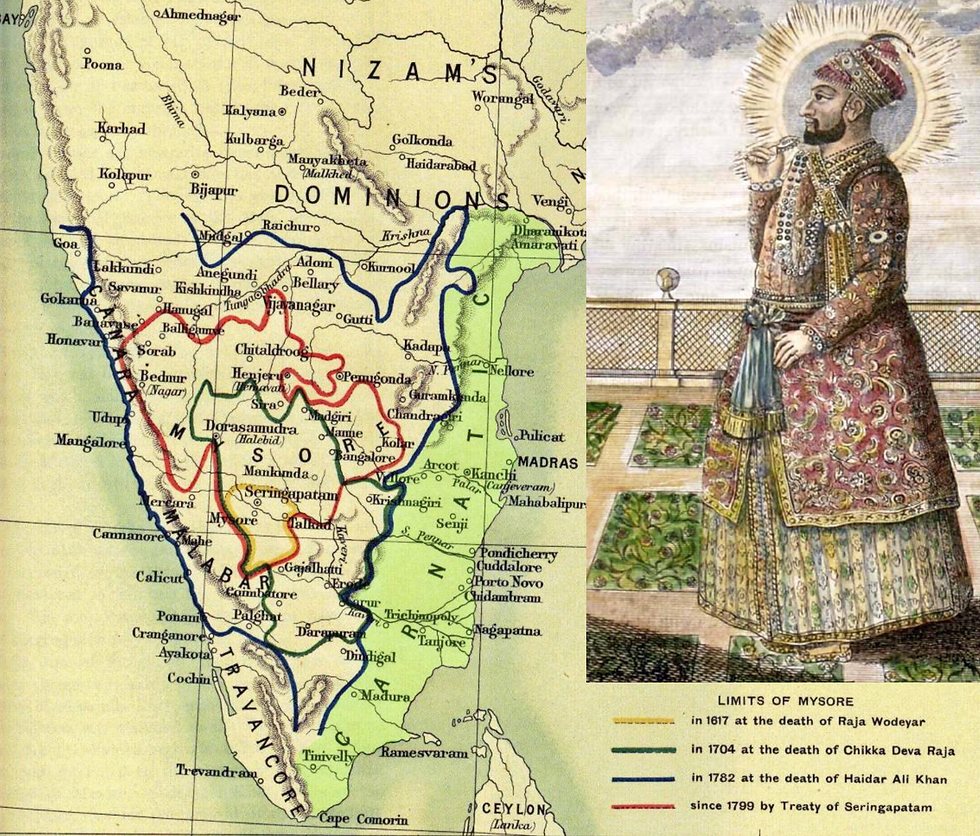
The 1740s were marked by conflict between the East India Company and the French, together with changing allegiances amongst the local princes and rulers. Stringer Lawrence raises the first East India Company troops for Madras in 1742, the Madras European Regiment, but Madras falls under French rule between 1746 and 1749. During this time Roderick Forbes is given his first command as Captain of Thomas Mostyns Company in Anjengo, on the 10th September 1747, which would be a test of his leadership as it had previously mutinied only nine months earlier.
During this time he finds himself in trouble for going against Company policy in selling arms to the Prince of Collastry, from whom he had received many ‘marks of favour… while in Amity with the Government of Tellicherry’. Evidently his side-hustle in dealing arms to local princes was a necessary supplement to his soldier’s pay: when he is transferred to Bombay in 1750 he is unable to settle his debts of 1068 Rupees for want of cash, so his house is sold in lieu.
Fort St George in 1717 Fort St George under French Occupation
Captain Forbes is engaged in a number of expeditions with the Bombay European Regiment, including a daring effort against the Sciddee at Oomtra, a Factory at Surat on 3rd April 1752 and the reinforcement of Stringer Lawrence’s Corps with Captain de Zeigler against the French and Mysoreans at Elmiseram in June 1754.
Still – the bureaucracy for which the East India Company was renowned was never far away… he writes from Fort St George, Madras on 12th June 1754 requesting a horse to take him to meet Stringer and receives reply five days later, with provision of a horse albeit only until he is able to join with Stringer’s forces. He participated in a ‘grand review before the Rajah of Tanjore’ before facing the enemy in battle on 17th August, against the forces of M. Maissin and the famous Hyder Ali. Despite being outnumbered three-to-one they prevail.
Following a year plundering and looting through Manupar, Tinnivelly and Nelli Cottah to Trichinopoly at the behest of the Nawab of Arcot and under a force commanded by Lt Colonel Alexander Heron, who would be court-martialled for bribery and corruption and dismissed from the service of the East India Company, the most notable engagement in which Captain Roderick Forbes took a leading part was the attack on the ‘Maratha Pirates’ and the Seige of Gheriah in late 1755 and early 1756.
The Marathas were notionally allies of the East India Company, but there were some who refused to accept this alliance – led by the pirate Toolajee Angria - who harassed the Company’s ships along the ‘Pirate Coast’ of the Malabar between Goa and Bombay from their safe-haven in the heavily fortified ancient capital of Gheriah, modern-day Vijaydurg. An Anglo-Maratha expedition was sent to quash the resistance once and for all, with the Maratha army making an attack by land and the Bombay marines launching a sea assault.
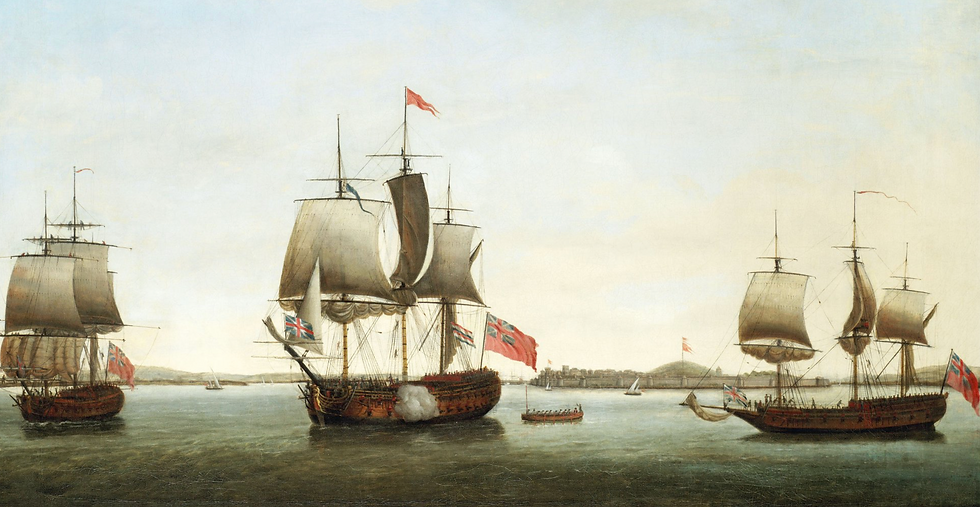
Drawing up to the pirate fleet, which was tightly moored together in harbour alongside the Company ship Restoration which had been captured six years earlier, the King’s and Company’s ships led by the 40-gun warship Protector rained shot and shell from a range of less than a hundred yards, causing ‘fearful casualties’ according to one deserter, and after two hours set the Restoration on fire which quickly spread to the remaining fleet, completely destroying it.
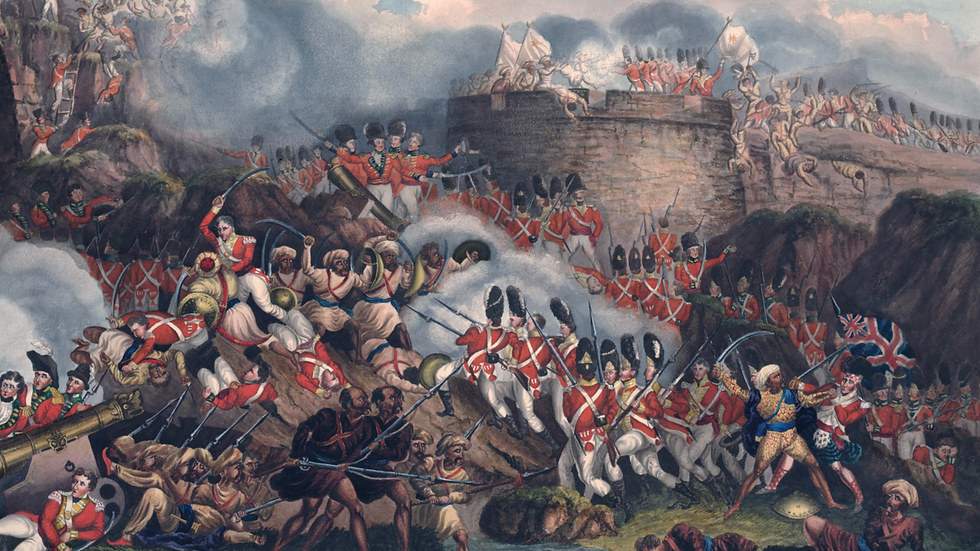
Lt Colonel Robert Clive then led the land assault on the Fort at Gheriah on the 11th February 1756. Although now held prisoner, Toolajee was able to send word to the Governor of the Fort urging them to resist surrender and a deadly and destructive bombardment commenced until Clive was finally able to secure a surrender.

Captain Roderick Forbes, together with Captain Andrew Buchanan, commanded the companies tasked by Clive of occupying the Fort after its fall. That night they were each bribed 50,000 Rupees (today, approximately over $1 million) by the Marathas to allow them access instead, but they refused and informed Clive; an act which earned Buchanan (but, curiously, not Forbes) a medal worth 290 Rupees for “consideration of his extraordinary good behaviour at the capture of Gheriah.” The episode is later chronicled by John Biddulph in his 1907 account ‘The Pirates of the Malabar’:
“Sixty men, under Captains Forbes and Buchanan, were marched up to hold the gate for the night. A body of the Peishwa's troops tried to gain admission, and offered the officers a bill on Bombay for a lakh of rupees to allow them to pass in. The offer was rejected, but the Peishwa's officer still continued to press in, till Forbes faced his men about, and, drawing his sword, swore he would cut him down if he persisted.”
Roderick Forbes’ son Richard is born in Bombay before 1750, possibly in 1748. His mother’s name was Jane and there is little we know about her, but it seems highly likely that she was an Indian woman whom Roderick met and married during his time in the service of the Company. Roderick and Jane had two other children - a son Charles Augustus baptised 1752, and daughter Mary Anne Sarah Forbes born 1759 - but they do not live beyond childhood.
Roderick Forbes died on Sunday 27th April 1760 in Gombroon, Persia – now known as Bandar Abbas in modern-day Iran. He had been travelling back and forth between Bombay and Gombroon, where the Company was dealing with insubordination among the military provoked by ‘neglect and arrogance of the council’. Aged 49, it is not clear why he died but – along with every other minutiae of bureaucratic detail pertaining to Company business – it was recorded in the Diary and Consultations of Mr Alexander Douglas, Agent of the East India Company at Gombroon.
Roderick Forbes Death EIC Letter Informing of Death of Roderick Forbes Gombroon, Persia
Little more is known of his wife in Bombay or the upbringing of their son Richard, other than that a Petition was made on 20th May 1760 to the Company by Mrs Jane Forbes, shortly after she became a widow, asking for pecuniary assistance. This request is granted with a pension of 40 Rupees per month 'on account of her husband having left her in great distress with 3 small children.' Their daughter dies two years later, and Jane dies in 1772.
A Richard Forbes appears in the Muster Rolls of the Bombay Military in Roderick Forbes' Company under a list of Europeans between 1755 and 1759, where he is described as a 'Cadet'. Although only a very young boy of between 7 and 11, this may have been his early life unless it refers to a different and unrelated Richard Forbes. After 1760 - Roderick's death - this Richard Forbes is described as a 'Volunteer' in another officer's Company.
Roderick and Jane’s son, Richard Forbes, also enters the service of the East India Company following a petition in 1775 to the Court of Directors in which he invokes the good reputation of his father as well as “... flatters himself [that] many of your Honourable Court knew his father and his faithful services which he hopes will be one motive to induce you to comply with his request…”
He is appointed a Cadet in the 1st Bengal Native Infantry on 25 October 1775, and then as an Ensign on 5th March 1777 and rose to the rank of Lt Colonel by 1801, participating in the Second Maharatta War with the 1/15th Native Infantry at the Battles of Dehli, Agra and Laswari. He was invalided on 26th January 1804 and subsequently commanded the 2nd Battalion Native Invalids at Fort Chunar where he lived until he died on the 17th February 1813.

Although we have supposed that Richard’s mother was native to India, we know for certain that his wife ‘Rebecca’ was a young Indian woman who was a convert to Christianity as some of their story is recounted in a touching tribute to her in his will:
“I leave and bequeath all my property that I now or may hereafter possess to be equally divided among my illegitimate children who may be alive at the time of my death – born of a Native Woman now deceased commonly known by the Name of Rebecca Forbes, by which name she was christened upon becoming a Christian of the Roman Catholick Faith.
I was married to this much lamented woman by a Roman Catholick Priest and we lived happy together for above thirty four years and I always looked upon her as my wife and my children as my lawful children but having never been married to her by the rights of the English Church My children by her of which one son and five daughters are to the best of my knowledge now alive – will be considered by law as illegitimate and as such I have specified them in this my last will and testament to prevent any sort of doubt and dispute as much as possible.”

The children of Richard and Rebecca Forbes come to Australia in the early 1800s, the last arriving in 1817. Their grandson Frederick Augustus Forbes – my 3xgreat-grandfather and the earliest of my forebears to be born in Australia in 1818 – became the third Speaker of the Legislative Assembly of Queensland in 1871. His daughter Diamantina would marry into another family of Scottish descent who found their way to Australia via India.
The 'Madras Roads' looking out from Fort St George Robert Clive's House, Fort St George Robert Clive's House, Fort St George St Mary's Church, Fort St George - the oldest Anglican church 'East of Suez' Yours truly on a Sunday morning 'Snobs Alley' - Houses of the era in Fort St George A contemporary depiction of a Fort St George streetscape The oldest house in Madras - the 'last house on Snob's Alley'


A colourful history indeed!